Monday, 16 July 2018

IMPERIAL TRAMONTANO – THE place to stay to finish that book...


Our friend, the builder Mark Lomas, introduces us to some nice places.

He commissioned this painting, which I did as an acrylic on board. He and his family had been there last summer, so this modest hotel had some significance.
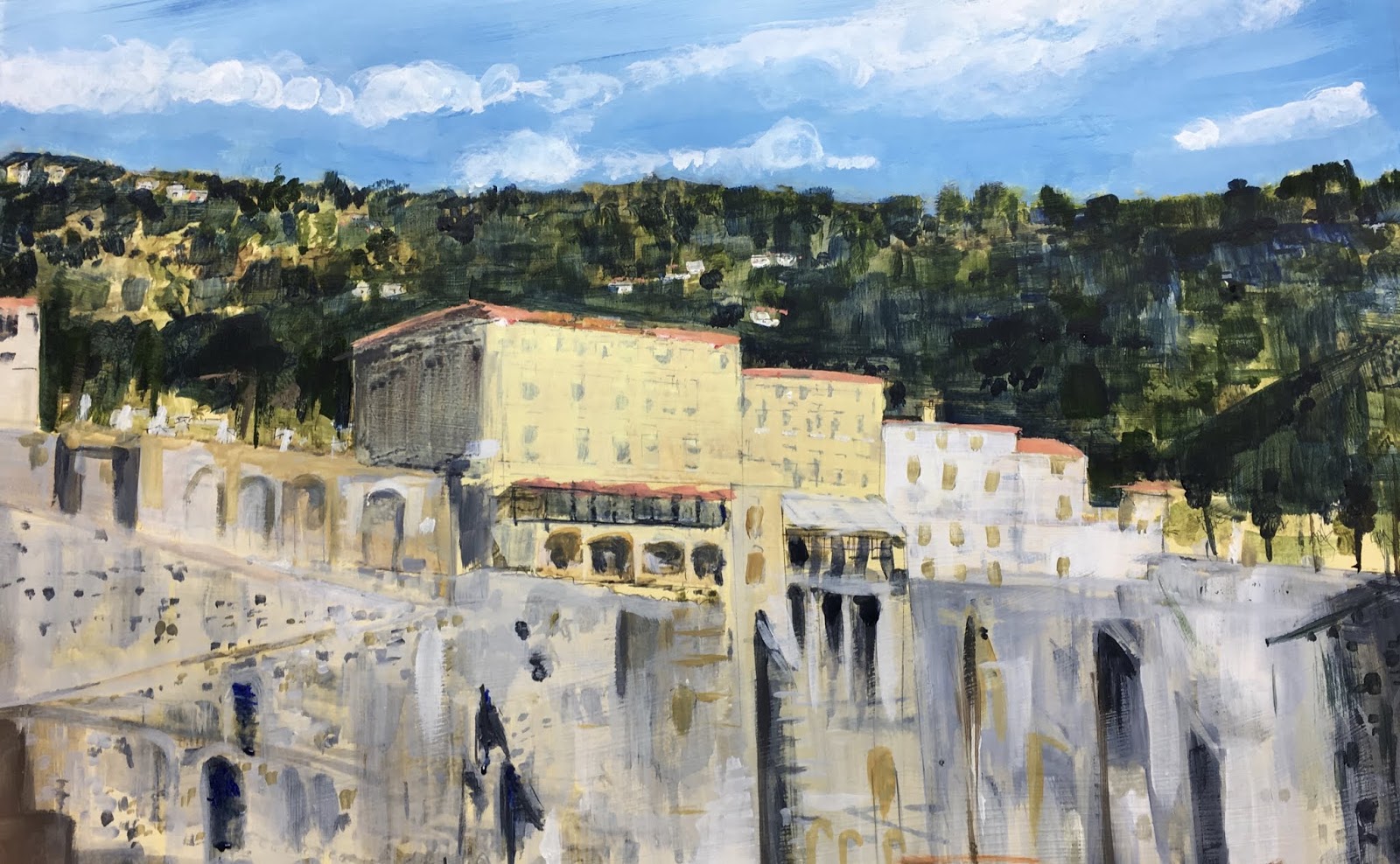
 
Hotel Tramontano  Acrylic on Board  60 x 43 cm
Intrigued, I did a bit of research. The hotel’s website provide insights with a tipicamente italianoflourish

' Since 1812, The Imperial Hotel Tramontano, overlooking the most beautiful part of the Gulf of Naples, nourished the romantic culture of the picturesque, sublime and landscapes of 19th century travellers visiting Sorrento. 

Along with the classic, refined and elegant style: the oldest wing dates back to the 16th century, and its architecture represent the most viewed image of Sorrento worldwide. In the background, the imposing profile of Vesuvius is silhouetted against a sky blazing with romantic sunsets. 

Throughout its long history, originally as a private residence then from 1812 as a hotel, the Imperial Hotel Tramontano has had the great privilege of playing host to the most important personages of the literary world.

It is now legend that Milton visited the hotel during one of his longer travel periods. 

Tramontano guests also include Goethe, Byron, Scott, Shelley, Lamartine, Musset, Keats, Leopardi and Longfellow. James Fennimore Cooper lived here until the completion of Water Witch, and it was here that Harriet Beecher Stowe found her inspiration for Agnes of Sorrento. During a six-month stay here, Ibsen wrote his immortal Ghosts. '

Saturday, 14 July 2018

House of Treasures

House of Treasures

Three different school groups were scurrying round the display cases. Everyone has a small drawing board, paper and pencil. I'd brought the Moleskine.

We are all chasing treasure down on paper. 

Treasure in glass cases, immaculately labelled. 

Objects that have come from every corner of our world: objects to adorn or disguise, to scare or decorate, objects to stab, club or cut, 

objects with which to dance, make music and mischief. 
Objects for war and to secure peace.

Objects everywhere, all of which entrance. We are at the Pitt Rivers Museum, Oxford.

'The Pitt Rivers Museum was founded in 1884 when Lt.-General Pitt Rivers, an influential figure in the development of archaeology and evolutionary anthropology, gave his collection to the University. His two conditions were that a museum was built to house it and that someone should be appointed to lecture in anthropology.'

https://www.prm.ox.ac.uk/collections

Thursday, 12 July 2018

CUXHAVEN REACHING THE COAST

FRIDAY Glückstadt - Cuxhaven (approx. 61 km) 
Elbe-Rad-Touristik takes us to our journey’s end


At the end of the last stage of our tour you arrive in Cuxhaven. You cross the river Elbe to the left side in Glückstadt. On this side you cycle through Freiburg to Otterndorf. 
Finally you arrive at your destination, Cuxhaven. 
You have many possibilities to relax here. The huge traps, which transport the tourists to the island Neuwerk, are unique; as well as the horse races on the sea floor. The ''Duhner Wattrennen'' is the highlight for everyone 


Enjoy your day in the North Sea spa resort of Cuxhaven - either at low or high tide! Today your tour along the Elbe comes to an end and you travel home on your own. We wish you a good trip home!

Wednesday, 11 July 2018

GLUCKSTADT SAMPLING THE HERRING

THURSDAY Hamburg - Glückstadt (approx. 68 km) 
Elbe-Rad-Touristik says do sample the herring
Today you cycle along the river Elbe from Hamburg Altone through Blankensee to Wedel. You cross Uetersen through the Elbe river floodplains and get to Elmshorn. The central point is the densely populated town centre. Here you can see the 630 years old Nikolai church, which is one of the prettiest ones in this area. 


Today's aim is Glückstadt. Christian IV. King of Denmark established Glückstadt in 1617. There are lots of things to discover in the port. If fishing cutter, sailing yacht or vintage car race, there is always something going on. Glückstadt is famous for its' culinary specialties like "Glückstädter Matjes" as well. 
Planned as a star-shaped city based on the Italian Renaissance style, Glückstadt was built as a fortress city and maritime port in 1617. The intact skyline of old warehouses represents the pride and wealth of this former capital of Schleswig and Holstein. A culinaric speciality, you should definitely try, are the salted Matjes. (HERRINGS)
ANOTHER lively from the excellent guide by Elbe Rad Turistik our brilliant organisers. www.elbe-rad-touristik.de

Tuesday, 10 July 2018

HAMBURG 'ITS A TOUGH CALL'

WEDNESDAY Lauenburg - Hamburg (approx. 55 km) 
Elbe-Rad-Touristik takes us to the naughty city
(I am borrowing liberally from the excellent guide by Elbe Rad Turistik our brilliant organisers. www.elbe-rad-touristik.de)

' On the eastern side of the Elbe you soon reach Geesthacht. The city is located in the southwest district of Herzogtum Lauenburg. It has almost 30.000 inhabitants, is the largest town of the district and one of the oldest settlements in the region. It was first mentioned in a documentary in 1216. It was famous because of Alfred Nobel who invented here in his powder factory the dynamite. 
Then you continue on the Elbdamm past many small villages and reach Hamburg. Experience Hamburg on a city tour or take a boat tour to see the historic warehouse district - the largest continuous warehouse complex in the world. Beautiful parks in Hamburg offer opportunities for recreation and relaxation.


The lively Hanseatic City has something to offer for everybody - on Sunday mornings at the fish market or late at night in Sankt Pauli. For the rest of the time it is a tough call between a harbour tour, a warehouse district tour, visiting museums and the art gallery or enjoying one of the outstanding musicals in the evening.' 

Monday, 9 July 2018

LAUENBURG A TYPICAL SAILOR TOWN

TUESDAY Hitzacker - Lauenburg (approx. 55 km) 
Elbe-Rad-Touristik moves us on…
"Lauenburg is a typical sailor town on the old salt road between Lüneburg and Lübeck. 
The city is dominated by the German brick architecture. 
A remarkable number of historic buildings are "downhill" in the lower town. Worth seeing are for example the oldest lock chamber of northern Europe on the Elbe-Lübeck canal, named after its builder Palm. 


Sunday, 8 July 2018

CYCLING THE ELBE

Our Elbe River Cycle tour reached its the final stage in May this year. I am borrowing liberally from the excellent guide by Elbe Rad Turistik our brilliant organisers. www.elbe-rad-touristik.de

' SUNDAY Elbe-Rad-Touristik picks up the story

Today you travel to Wittenberge, the biggest town of the Prignitz area. Its port belongs to the most important ones at the river Elbe. 


MONDAY Wittenberge - Hitzacker (approx. 70 km) 
On the western side of the Elbe you first past Wahrenberg where also are many storks. There it is very quiet, because it is situated behind a dike. In the past it was often threatened by high water. The area at Wahrenberg belongs to the bird protection area of Europe and with its meadows and ponds it is a paradise for nature lovers. 
In Aulosen you can visit an open-air model of the former inner-German border with original parts.

The Border Museum of Schnackenburg reminds at the 45-year-long division of Germany. Your today's destination is Hitzacker, which is famous for its beautiful old town with its half-timbered houses and the German brick architecture.