Saturday, 21 January 2017

Baroque, one locked, three lovely churches

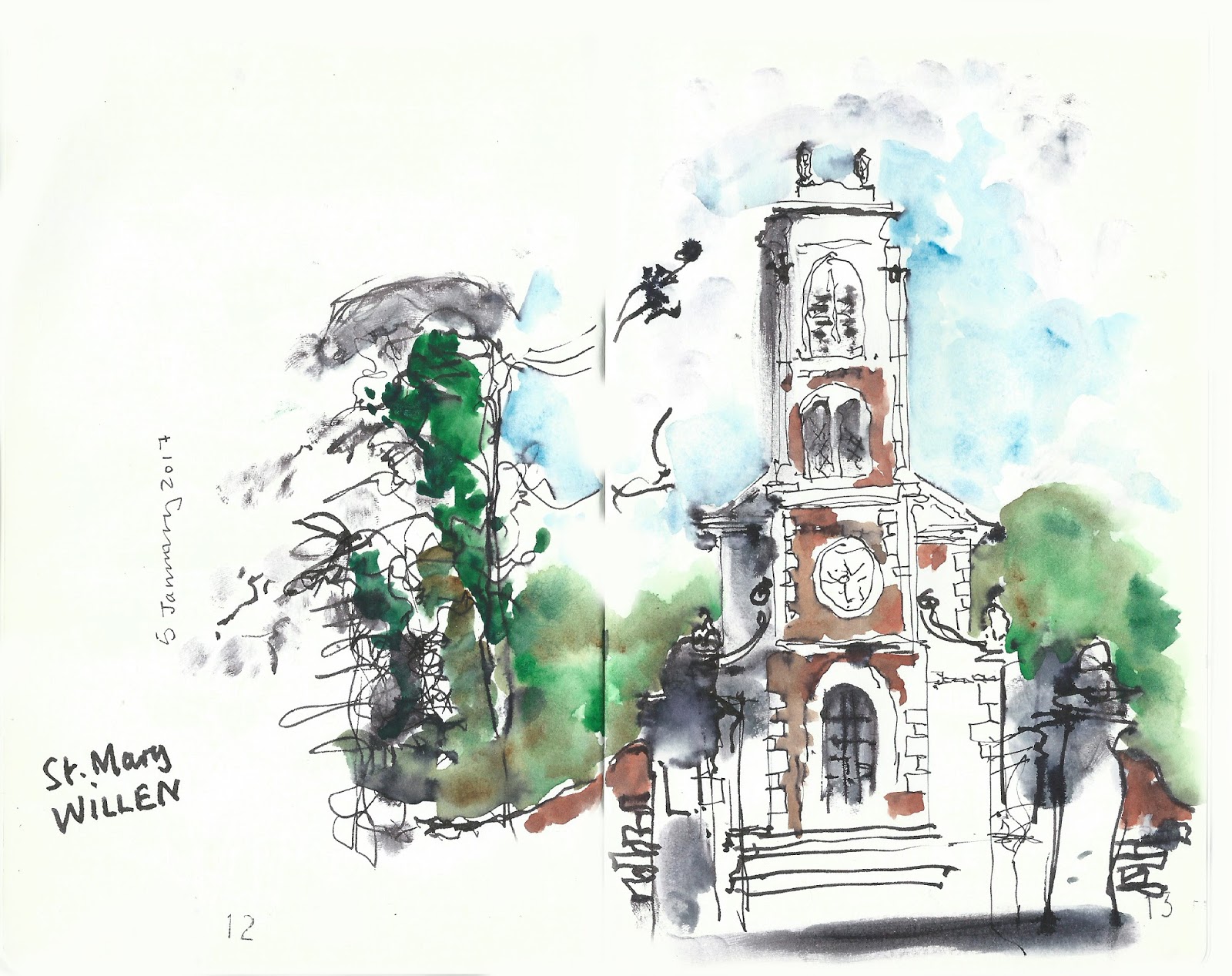
WILLEN St Mary
Is a classical gem possible in the Milton Keynes landscape?
Built in 1680 St Mary building is charming, an adjective not often associated with MK.
It was locked, so we missed or    rather glimpsed through the apse window, the pink wash with white plasterwork and missed the wall panelling and box pews. We will return!

OLNEY St Peter and St Paul 
Olney was the childhood home of the architect George Gilbert Scott and residence of William Cowper English poet and hymnodist. So one expects grand things. The early 14th-century tower rises beyond a meadow by the River Ouse.
The Victorian ‘laying of hands’ dominates a nave and chancel restored by Scott in the 1870s.
Olney's interior is spacious but scraped and heavily ‘refurbished’ in the Victorian manner, as a church more Midlands than Home Counties.

GAYHURST St Peter
Gayhurst church is reached through the main gates to the big house.
The house passed through the hands of Sir Francis Drake and Everard Digby (of the Gunpowder Plot) before the Wrighte family acquired it in 1704 and built a new church in the style of Wren, bless ‘em. Two baroque wonderments just down the road from each other

-->
And Gayhurst's wow factor is the monument to Sir George Wrighte and his son. This is a superb work of Baroque modelling  - Mr Pevsner approves. Both father and son stand bordered by Corinthian columns as if modelling their Georgian get-ups. The box pews are intact, that of the Wrighte family, of course.

Honey coloured Baroque bathed in sunlight

Superb Baroque


Thursday, 19 January 2017

Scourie - Furthest north and west a bit


Hills around Scourie 350 million years ago!

Oh, we must be talking about Scourie again, a remote area in the far Northwest Highlands of Scotland.

Yes, a perfect place to spend New Years eve and day.
An on the 1st of January we walked up the huge hill that overlooks the village and looked down.

Oh, and then looking over to the East, three big hills. These were, built 350 million years ago and each one is +/- 700 metres high and one wonders were they built to that height at precisely that time or did they grow over time.

No matter, an incredible sight on a sunny new years day!

At the edge of the Laxford Estuary

New Year's Day: Looking east to the hills 


-->
Again we were with friends Fiona, Charlotte and Richard Campbell who again in a few months time will be re-opening the Scourie Hotel to an adoring clientele, especially those fishermen in search of wild brown trout!

Monday, 16 January 2017

A velvet crab


Fierce storms on the farthest NW tip of Scotland caused much to be washed up on the shore.

It was the day before the New Year, again we were in Scourie. Beach combing along the edge of the Laxford estuary we happened on several velvet crabs.


It is also know as the velvet swimming crab, devil crab or lady crab and is the largest swimming crab in British coastal waters with a body width of up to 100 millimetres (3.9 in which is coated with short hairs, giving the animal a silky texture.

Lying on the shoreline this creature looked so very grand and colourful.


Thursday, 29 December 2016

Chenies Church – Through a glass, darkly


Resting gracefully in the Bedford Chapel 

A gentle knight at ease

The tone of Simon Jenkins' description of St Michael’s church* in Chenies village is peevish. As the particular riches in St Michael’s are incarcerated behind a screen of wrought iron and glass. His grumble and mine. This chapel of monuments, the Bedford Chapel

is denied us. The chapel (runs the length of the church on the north side). a monument (1556) to the Dukes of Bedford (Russell Family) and a collection of funerary loveliness that extends 500 years. 

At noon, on the day of my visit, although the church in near darkness, you could just make out the shapes and colours of these resting places and their attendant banners.

Squinting through the glass and iron screen I could just make out these exciting forms of tombs and monuments and made two drawings. 

Perhaps one day as Jenkins suggests ‘proper access should be permitted or the wall redesigned to give a better view from the nave.'

For now we see through a glass, darkly; but then face-to-face: now I know in part; but then shall I know even as also I am known. 1 Corinthians 13:12


*England's Thousand Best Churches by Simon Jenkins 1999

Wednesday, 28 December 2016

Felix Fieldfare


Felix the fieldfare in hedges and fields,
For worms and berries and whatever yields.

Always in winter,
Usually with mates,

He’ll scurry around,
to put bread on the plate.

Tuesday, 27 December 2016

Jordans - Westminster Abbey near Beaconsfield


Peaceful interior Jordans Meeting House


Society of Friends Meeting House in Jordans

Now for something completely different and it is located on the doorstep.

Jordans is the Quaker Westminster Abbey*.’ James II’s Declaration of Indulgence 1687 meant Charles Fox and chums could get to work, laying the foundations of the Meeting House we see today.


The warm red brick exterior is unchanged.

Inside a calmness that is impermeable to anything but a silent peace. This is a place of worship that is stripped of all distraction and temptation to eulogise or bumble. Plain walls of white with wood panelling and simple furniture that has witnessed much listening and prayer.

*Quoted from Simon Jenkins' England's Thousand Best Churches 1999