Monday, 26 March 2018

Industrielandschaft: Rüdersdorf


Two journeys along the River Elbe and a third planned in May this year, has brought me into close to industrial buildings that hover on the edge of landscape. Inspiration for picture-making.

These are places where to quote the poet Paul Farley
‘.. as difficult to pin down and define as poetry, but like poetry you’d know it when you saw it. … Decay and stasis, but … also dynamic and mysterious’.

These places are all around.

Statis Rudersdorf      Acrylic on Paper      40 cm x 60 cm


I discovered a photograph of the ruins of the VEB Chemiewerk Coswig facility in Rüdersdorf, not far from Berlin.

This remarkable place was was built in 1899 as a cement factory, but by World War Two it was producing chemicals for the Nazi war effort. After the war, the plant was stripped by the Soviets and used as a transit camp for prisoners destined for the USSR.

In 1950, it was pressed back into operation to manufacture phosphates, and the production of agricultural chemicals and compounds. These works were close to huge agricultural collectives of the DDR, fields through which I cycled in 2016 and 2017.

After permanently closing in 1999, the deserted industrial site became a favourite haunt of filmmakers.


The design of these places is a pure flight of fantasy. 

Sunday, 4 March 2018

Winter Hedgerow Monoprint  20 x 30 cm   Oil paint on news print 


WINTER HEDGEROW 
All around us the wind scraps and spreads the snow!

“I prefer winter and fall, when you feel the bone structure in the landscape – the loneliness of it – the dead feeling of winter. 
Something waits beneath it – t
he whole story doesn’t show.” 

Andrew Wyeth

Saturday, 3 March 2018

A Handshake in New York

Many of us like/love/ love to go back to New York. And sometimes the whole ‘New York experience’ is vicarious 

So, when a top concierge/travel company discovers your blog and falls hopelessly in love with your work, you cannot wait to play. 

Handshake New York is an advisory and concierge service taking great care of travellers to the New York area and locals too!  Owner Patrick Baynes (no relation) and I are going to embark on creating a series of limited edition prints from my drawings of this fab city.

If going to NYC find Patrick and his team here https://www.handshakenewyork.com


Here are 11 fairly portraits of New York 


Friday, 2 March 2018

La brillantez de Balenziaga: Frocks that rock!


Since he opened his first shop, in 1919, Cristóbal Balenciaga has been entrancing his clientele and us mere mortals with great frocks.

His bubble skirts and odd, feminine, yet ultra-modern shapes were (sorry are) unmistakeable qualities of his creative approach and the fashion house he founded, which continues today.

He is "The master of us all" said Christian Dior

AND The V&A always puts on a good show of frocks.

Just finished is an exhibition that examined the work and legacy of influential Spanish couturier.

There were over a hundred pieces crafted by ‘the master’ of couture, his protégées and contemporary fashion designers working in the same innovative tradition.


My top pick was a darling evening mini-dress by Emanuel Ungaro (who worked for the Master). 

A sense of place

Some places truly strike a cord.
These are places that preoccupy you for many days after your visit. 
The place you really cannot wait to get back to. It may be down the road, a field where you regularly walk, or across the other side of the world, a beach or a street or a bay.

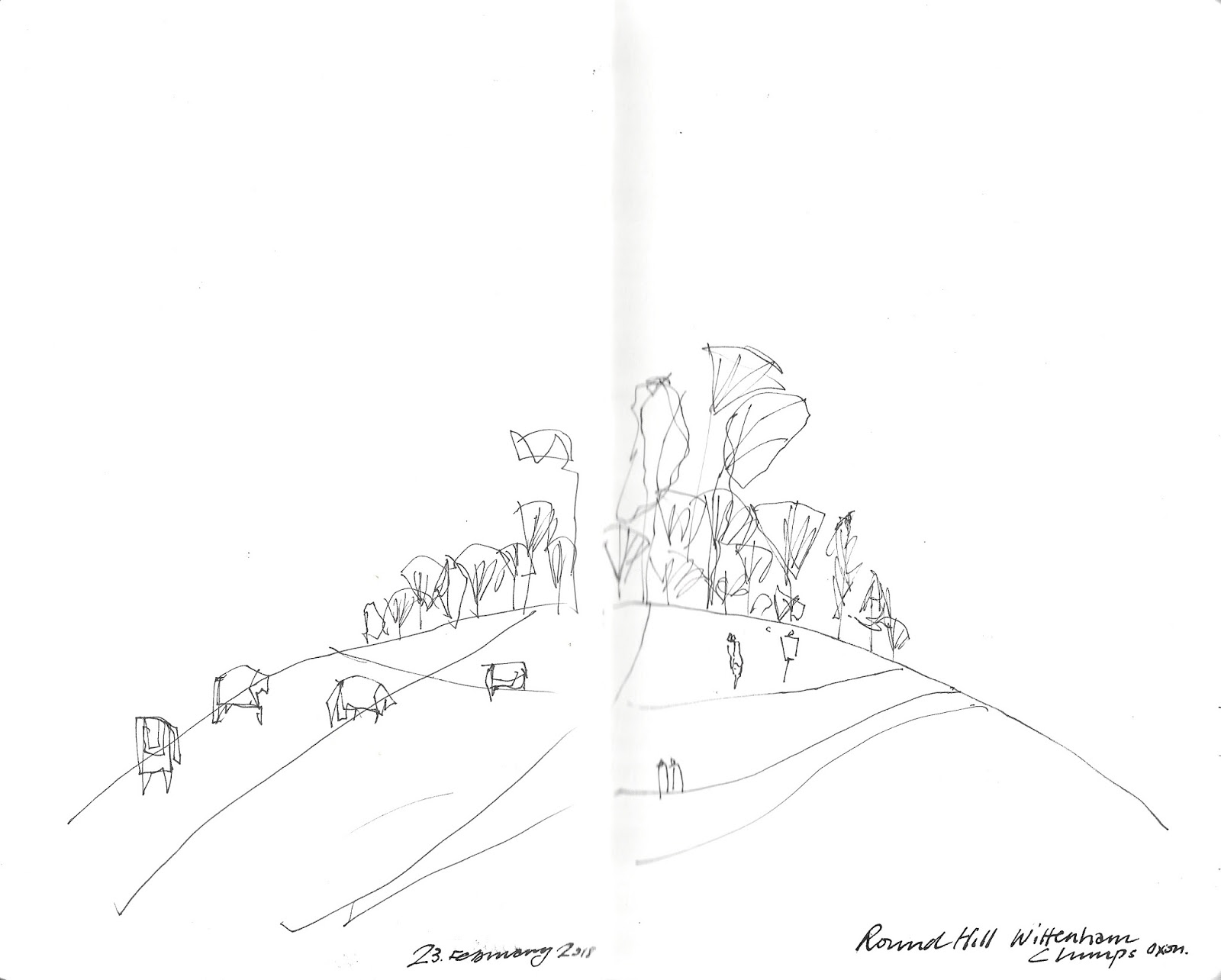
Whittenham Clumps in Oxfordshire is one of my places. 

I walked past this spot  in July 2103 with two friends as we walked the Thames Path. I immediately created a linocut from the drawing I made at that time.

2013 Whittenham Clumps in Oxfordshire, one of my places.


It has been at the back of my mind since as a magic place, there, but not quite.

Last Friday with my cousin Wendy and Rosie the Puppy we to the summit of Round Hill and then across to Castle Hill its sister, both comprise the Clumps.

An on the spot quick sketch. 

Just enough information to develop into a painting.


Remarkable views, you look across Oxfordshire to the north, Chilterns to the East, South and West across the Berkshire Downs and Wiltshire.

The artist Paul Nash, who first saw them in 1911, described the view from The Clumps: "a beautiful legendary country haunted by old gods long forgotten"

This place has been the site being occupied since the Bronze Age around 1000 BC.


Paul Nash repeatedly painted Wittenham Clumps. I hope to follow in his wake, in a more industrious fashion than I have hitherto.

Thursday, 1 March 2018

On Mission in San Antonio


It was Spain’s last throw of the colonial dice, a determined drift up through South America. Into the North American continent converting the local Native Americans to the Church of Rome along the way.

A Mission was a community, run by the Catholic priests and brothers, dispatched from Spain, blessed by Rome with the aim of ensuring the local population became Christian.  Included in the package was education, instruction in growing crops and tending livestock and protecting the Mission from marauders. All of which was centred on Christianity.


The Spanish Missions in Texas comprised a series of religious outposts established by Spanish Catholic Dominicans, Jesuits, and Franciscans to spread the Catholic doctrine among area Native Americans, and with the added benefit of giving Spain a toehold in the frontier land. In all, twenty-six missions were maintained for different lengths of time within the boundaries of what became of the state of Texas.

Physically the Mission was built around a church with other buildings and accommodation close by and walls for protection.

I was lucky enough to visit one only a twenty-minute public bus ride away from the centre of San Antonio: The Mission Nuestra Señora De La Purisima Concepción De Acuña. This handsome stone church was dedicated in 1755, and I saw it very much as it was over two centuries ago. It stands proudly as the oldest unrestored stone church in America.


This is an extract from the National Parks website.  I include it for it's additional perspective on why the Missions were so attractive to the local people. 

A NEW GOD AND KING
After 10,000 years, the people of South Texas found their cultures, their very lives under attack. In the early 1700s Apache raided from the north, deadly diseases travelled from Mexico, and drought lingered. Survival lay in the missions. By entering a mission, they foreswore their traditional life to become Spanish, accepting a new religion and pledging fealty to a distant and unseen king.